
If pharmaceutical exports from India to the US come under a 25 per cent tariff bracket, the impact on earnings before interest, tax, depreciation and amortisation (Ebitda) could be around 5 per cent, felt analysts. This is after assuming that about 75 per cent of the tariff would be passed on.

A ban on US-based high-frequency trader (HFT) Jane Street did little to dent activity in the derivatives segment, with July volumes rising 10 per cent month-on-month to an eight-month high. Analysts and experts said the jump may have come from proprietary and retail traders, spurred by a spike in market volatility.

The 15th India-Vietnam Defence Dialogue signalled a move from routine talks to deeper cooperation, with new deals on submarine rescue and defence industry to support stability in the Indo-Pacific, notes Dr Rajaram Panda.

For India to transform into a high-income country with a projected gross domestic product (GDP) of $23-35 trillion, will need a sustained annual growth of 8 per cent to 10 per cent. This will be powered by India's demographic dividend, technological innovation, and sectoral transformation, according to the "India@2047: Transforming India Into A Tech-Driven Economy" report by Bain & Company and Nasscom. By 2047, the services sector is expected to contribute 60 per cent of India's GDP, while manufacturing will account for 32 per cent, both playing a pivotal role in economic expansion.

However, as of now, container availability has not been seen as an issue as adequate empties are available. The Red Sea strait is vital for 30 per cent of global container traffic and 12 per cent of global trade.

Stock market participants would track global trends and foreign investors' trading activity in a holiday-shortened week ahead, amid lack of any major domestic trigger in sight, analysts said. Equity markets will remain closed on Wednesday for Christmas.

Macroeconomic data announcements, trading activity of foreign investors and global trends will guide equity market movement this week, which would also mark the beginning of the new calendar year and month, analysts said.

The MiG-21 episode demonstrates that procurement is always strategic.
Choices about what aircraft to acquire, who builds them, who supplies the spares, who trains the pilots and technicians are decisions with political consequences lasting for decades.

Centre mulls strategy to ensure powers given to the agencies are not misused.

From the 30-share blue-chip pack, Adani Ports dropped over 4 per cent. UltraTech Cement, Sun Pharma, IndusInd Bank, NTPC and Tata Steel were also the among the laggards. Nestle, ICICI Bank, Infosys, Tata Consultancy Services and HCL Tech were among the gainers.

The 'mediation' by the United States from behind the scene on the diplomatic track appears to be once again working, which calls on both Delhi and Islamabad to show restraint and pull back from a military confrontation, notes Ambassador M K Bhadrakumar.

Countries negotiating free trade agreements (FTAs) need to keep in mind eight "myths" which surround these pacts, like they lead to accelerated increase in exports and promote domestic manufacturing, according to a report by think-tank GTRI. The report by Global Trade Research Initiative (GTRI) claims to dispel these 'myths', including that FTAs weaken the WTO (World Trade Organisation), countries are rushing to do FTAs, and these pacts promote investment and lower prices. It is "erroneously" believed that most world trade happens through the FTA route, but in reality, it is less than 20 per cent, said the report titled 'FTAs: Fabulous, Futile, or Flawed?'.

Trading sentiment in the equity market this week will be guided by global trends, foreign fund movement, macroeconomic data announcements and RBI's interest rate decision, analysts said. The monthly auto sales data announcement would also be tracked by investors this week.

Trump may temper his approach from time to time, but to think that he will change his basic philosophy is delusional, asserts T T Ram Mohan.

Bajaj Finance, Bajaj Finserv, NTPC, State Bank of India, Power Grid, HDFC Bank, Tech Mahindra and Asian Paints were the other gainers. However, Zomato, Adani Ports, Tata Consultancy Services, Mahindra & Mahindra, Maruti and Tata Motors were among the laggards.

Among the Sensex firms, Asian Paints, NTPC, Tata Motors, Bharti Airtel, State Bank of India, Larsen & Toubro, Wipro, Tech Mahindra, Tata Consultancy Services, ITC, HDFC Bank and Maruti were the biggest winners. Hindustan Unilever, Infosys, UltraTech Cement, Bajaj Finance, Nestle, Axis Bank, Reliance Industries and HDFC were among the laggards.

'If you align your ambition with India's rise, the peak of your careers will unfold alongside the peak of India's power.'

A host of macroeconomic data announcements, the last batch of September quarter earnings, global trends, and trading activity of foreign investors will be the major driving factors for the equity market this week, according to analysts. Equity markets would remain closed on Friday for Guru Nanak Jayanti. "India is set to release CPI and IIP data on November 12, with WPI data expected on November 14.

RBI's interest rate decision, macroeconomic data, global trends and trading activity of foreign investors are the crucial factors to drive equity markets in a holiday-shortened week ahead, analysts said. Markets would remain closed on Monday for Gandhi Jayanti. "While global cues will continue to dictate trends in local markets, focus will shift to RBI's monetary policy announcement on Friday. "Although the market is expecting a status quo on interest rates, global concerns like rising US dollar index and bond yields coupled with surging crude oil prices continue to weigh on investors' minds.

Equity benchmark indices Sensex and Nifty settled higher on Thursday, powered by a rally in banking and power stocks amid a largely firm trend in global markets. The stock markets mostly traded range-bound in the absence of any major trigger and persistent foreign capital outflows, traders said. The 30-share BSE Sensex rose 144.31 points, or 0.18 per cent, to settle at 81,611.41.

Indian drugmakers supply 47 per cent of the generic medicine requirements in the US, and tariffs would have increased prices in the US domestic market for patients, who are already dealing with drug shortages.

Investors' wealth eroded by Rs 9.51 lakh crore on Monday morning, following a crash in equity markets where the benchmark Sensex tanked over 2,400 points, mirroring a sharp plunge in global peers. The 30-share BSE benchmark tanked 2,401.49 points to 78,580.46 in early trade. Following the sharp decline in equities, the market capitalisation of BSE-listed firms dropped by Rs 9,51,771.37 crore to Rs 4,47,65,174.76 crore ($5.35 trillion) during the morning trade.
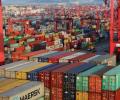
A healthy growth in India's services segments has helped the country's total exports and imports of goods and services to cross the $800 billion mark during the first half of 2023, despite a slowdown in global demand, think tank GTRI said in a report on Monday. According to the analysis of the Global Trade Research Initiative (GTRI), exports of goods and services rose by 1.5 per cent to $385.4 billion during January-June this year, as against $379.5 billion in January-June 2022. Imports, however, dipped by 5.9 per cent to $415.5 billion during the six months of this year, as against $441.7 billion in January-June 2022.
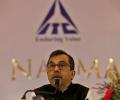
ITC's move to hive off its hotel business will have implications for passive funds and exchange traded funds (ETFs) similar to that seen during the Reliance Industries-Jio Financial demerger. As ITC is part of popular indices such as Nifty and Sensex, it is held by several index funds and ETFs.

India's largest drug maker Sun Pharmaceutical on Thursday posted a decline of 19 per cent year-on-year (Y-o-Y) for its consolidated net profit for the fourth quarter of the financial year 2025 (Q4FY25) at Rs 2,149.8 crore. Meanwhile, its revenue from operations rose by 8 per cent at Rs 12,958.8 crore.


'Despite the current uncertainties, the long-term outlook remains constructive due to strong fundamentals, government initiatives, and a stable banking sector.'

In response to the panic triggered by Trump's trade policies, the RBI net sold approximately $43 billion in the second half of FY25 to curb volatility, as the rupee plunged to a low of 87.95 per dollar in February this year.

The Reserve Bank of India's (RBI's) interest rate decision, West Asia conflict and trading activity of foreign investors are the key factors that will dictate investors' sentiment in the market this week, analysts said. Moreover, quarterly earnings from IT bellwether TCS, domestic macroeconomic data and movement in global oil benchmark Brent crude would also guide trends in the market. Worsening tensions in the Middle East and foreign fund outflows were the major culprits behind the equity markets sharp fall last week.

In 2024, the Securities and Exchange Board of India (Sebi) implemented significant reforms, focusing on cooling down the derivatives segment, enhancing transparency and accountability in small and midsised enterprise (SME) listings, and deepening the fund management ecosystem.

For investors who missed the initial IPO frenzy, the market correction is an opportunity to selectively invest in promising names, but patience and careful evaluation remain the key.

Gold, a safe-haven bet, is likely to continue its record-smashing journey in the New Year, rising to Rs 85,000 per 10 grams and even Rs 90,000 level in domestic markets if geopolitical tensions and global economic uncertainties continue.
Stock markets will be driven by domestic inflation data, ongoing quarterly earnings from corporates and global trends this week, analysts said. News flows around the general election would also be tracked by investors, market experts said.

Domestic macroeconomic data announcements, global trends and trading activity of foreign investors would guide market sentiments this week, analysts said. After a record rally, markets may face volatile trends this week amid elevated valuations and investors would also keep a track of global oil benchmark Brent crude and rupee-dollar movement for further cues. "Potential volatility in the stock market is anticipated this week. Elevated valuations remain a concern, with investors now focusing on monsoon progress and its impact on the rural economy.

From the Sensex pack, Tata Motors slumped over 7 per cent. Adani Ports, Tata Steel, SBI, Power Grid, JSW Steel and Maruti were the other big laggards. However, Hindustan Unilever and Nestle ended in positive territory.
The last batch of quarterly earnings, global trends and trading activity of foreign investors will guide the equity market movement in a holiday-shortened week ahead, analysts said. Volatility may continue amid investors' cautious approach in the election season. Markets will remain closed on Monday due to the fifth phase of the Lok Sabha elections in Mumbai.
Global trends, macroeconomic data announcements and the start of the earnings season would be the major drivers for the equity markets in a holiday-shortened week, analysts said. Equity markets will remain closed on Thursday for Eid-Ul-Fitr. Trading activity of foreign investors, rupee-dollar trends and crude oil prices would also guide trends in markets.
Equity markets would take cues from domestic inflation data announcement, global trends and trading activity of foreign investors in a holiday-shortened week ahead, analysts said. Markets would remain closed on Tuesday for 'Diwali Balipratipada'. "As we enter a truncated week with Muhurat trading on Sunday, global cues will play a pivotal role in shaping the market direction.

Foreign investors have poured Rs 57,359 crore into Indian equities in September, making it the highest inflow in nine months, mainly driven by a rate cut by the US Federal Reserve. With this infusion, foreign portfolio investors' (FPIs) investment in equities has surpassed the Rs 1 lakh crore mark in 2024, data with the depositories showed. Going ahead, FPI inflows are likely to remain robust, driven by global interest rate easing and India's strong fundamentals.

'The future of BRICS is under stress as Chinese attempts to expand the platform are being resisted by India and Brazil.' 'Beijing is focused on a quick expansion with the aim of giving the platform a distinctly anti-Western orientation, which New Delhi and Brasilia seem to have no interest in,' notes Harsh V Pant.
